

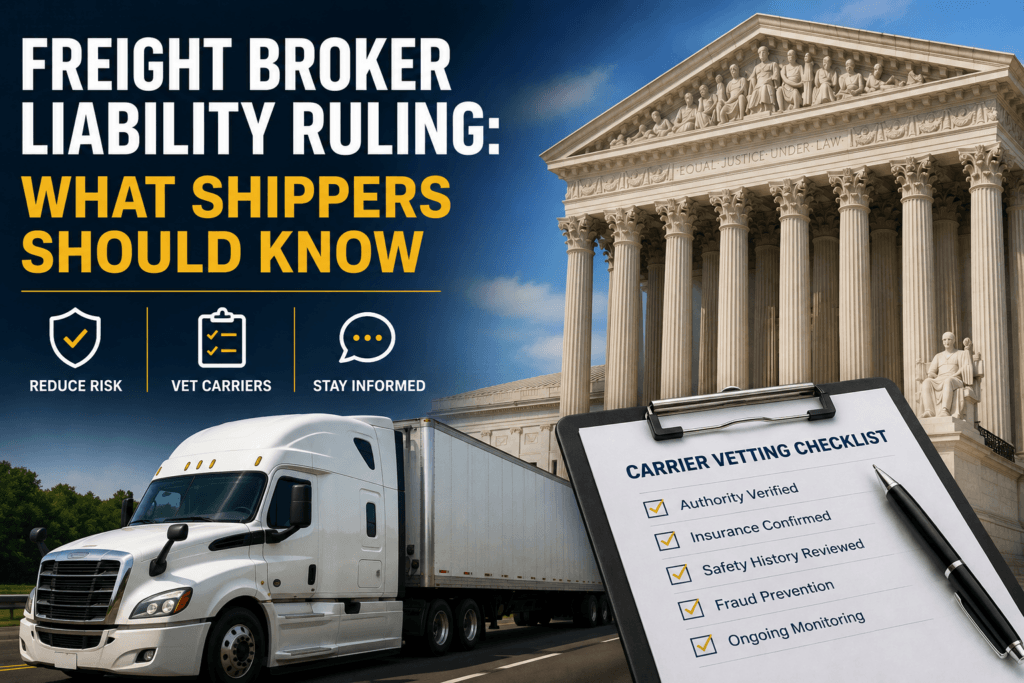
What the Supreme Court Freight Broker Liability Ruling Means for Shippers
A recent Supreme Court ruling has put freight broker liability, carrier selection, and safety vetting back in the spotlight.
For shippers, this is not just a legal headline.
It is a reminder that the company arranging your freight matters, the carrier selected matters, and the process behind that selection matters.
Freight is not just about finding a truck. It is about choosing the right transportation partner, checking for risk, documenting the process, and communicating clearly from pickup through delivery.
What Happened?
The Supreme Court recently allowed a lawsuit against freight broker C.H. Robinson to move forward after a serious trucking accident involving a carrier selected for a shipment.
The case involves a negligent-hiring claim. In simple terms, the injured party argued that the freight broker should bear responsibility for selecting a carrier that allegedly had safety concerns.
The Court did not decide whether the broker is ultimately liable.
Instead, the ruling means the lawsuit can proceed and be argued further under state law because the claim falls within a safety-related exception.
That distinction is important. This is not a final liability ruling, but it is still a major development for freight brokers, carriers, shippers, and anyone involved in transportation decisions.
Why Shippers Should Care
Most shippers are focused on moving freight safely, on time, and at a reasonable cost.
That makes sense.
But this ruling is a reminder that the lowest rate is not always the lowest-risk option.
When a broker or logistics provider does not take carrier selection seriously, the shipper may not always see the risk upfront. The load may look covered. The rate may look good. The paperwork may look normal.
But behind the scenes, questions still matter:
- Was the carrier properly vetted?
- Was authority active?
- Was insurance reviewed?
- Were safety concerns checked?
- Was the carrier actually who they claimed to be?
- Were fraud warning signs taken seriously?
Those are not small details.
They are part of responsible freight planning.
Carrier Selection Is Not Just a Checkbox
Carrier vetting should never be treated like a quick box to check before sending a rate confirmation.
Good carrier selection looks at more than whether a truck is available.
It should include practical review of things like:
- Operating authority
- Insurance status
- Safety information
- Inspection history
- Carrier identity verification
- Communication patterns
- Fraud warning signs
That does not mean every risk can be eliminated.
Freight still moves in the real world, and the real world occasionally behaves like it skipped the morning meeting.
But a strong vetting process helps reduce avoidable risk and creates a more responsible way to manage shipments.
What This Means for Freight Brokers
This ruling may increase attention on how freight brokers select and monitor carriers.
That does not mean every broker will automatically be liable for every accident involving a carrier.
But it does reinforce that broker practices matter.
Freight brokers who rely only on speed, price, or load board availability may expose shippers to more risk than they realize.
Responsible freight brokerage should include:
- Careful carrier review
- Clear documentation
- Fraud prevention practices
- Shipment visibility
- Proactive communication
- Practical decision-making when something does not look right
This is where experience, process, and judgment matter.
What Shippers Should Ask Their Freight Partners
Shippers do not need to become transportation lawyers.
But they should ask better questions.
Before trusting a broker or logistics provider with freight, it is reasonable to ask:
- How do you vet carriers?
- How often do you review carrier safety and insurance information?
- What fraud prevention steps do you use?
- How do you verify carrier identity?
- How do you communicate shipment updates?
- What happens if something about a carrier does not look right?
If the answer is basically, “We find the cheapest truck and hope for the best,” that is not a logistics strategy.
That is a coin flip wearing a safety vest.
How Whitewater Freight Helps Reduce Risk
At Whitewater Freight, carrier selection is not treated as an afterthought.
We help shippers coordinate freight through carefully reviewed carrier partners, with attention to practical risk management, communication, and shipment visibility.
Our process is built around doing freight the right way, including:
- Reviewing carrier details before assigning freight
- Monitoring important safety and insurance information
- Watching for fraud warning signs
- Communicating clearly throughout the shipment process
- Matching freight to the right transportation solution
You can learn more about our approach to freight fraud prevention and carrier vetting.
Why This Matters Beyond One Court Case
This ruling is bigger than one company or one lawsuit.
It highlights a reality shippers already know: transportation decisions carry risk.
That risk can show up as freight fraud, cargo claims, delays, service failures, accidents, or legal exposure.
The goal is not to scare shippers.
The goal is to help shippers understand that freight decisions should be made carefully, not casually.
Whether you are moving truckload freight, LTL freight, flatbed freight, or urgent freight, the carrier behind the shipment matters.
The Bottom Line
The Supreme Court freight broker liability ruling is a reminder that carrier selection matters.
For shippers, the lesson is straightforward: ask how your freight partners choose carriers, how they manage risk, and how they communicate when something changes.
The cheapest option may look good upfront, but weak carrier vetting can become expensive quickly.
Freight should move with a plan, not a shrug.
Whitewater Freight helps shippers coordinate freight with practical planning, careful carrier selection, and real communication from pickup through delivery.
You can review our broader freight services or request a freight quote for an upcoming shipment.
FAQ
What did the Supreme Court decide about freight broker liability?
The Court allowed a negligent-hiring lawsuit against a freight broker to proceed. It did not decide final liability, but it ruled that the claim could move forward under a safety-related exception.
Does this mean freight brokers are always liable for carrier accidents?
No. The ruling does not automatically make brokers liable for every accident. It does, however, increase attention on how brokers select and vet carriers.
Why should shippers care about carrier vetting?
Carrier vetting helps reduce risk before a shipment moves. It can help identify safety concerns, insurance issues, authority problems, fraud risks, and communication red flags.
What should shippers ask their freight broker?
Shippers should ask how carriers are reviewed, how often safety and insurance information is checked, how fraud risks are handled, and how shipment communication is managed.
Is this article legal advice?
No. This article is for general freight education only. Shippers should consult qualified legal counsel for advice about specific legal questions or liability concerns.
Freight without the surprise party.
Need help moving freight without the surprises?
Whitewater Freight helps shippers move truckload, LTL, flatbed, hot shot, and partial loads with proactive communication, careful carrier vetting, and real humans who answer the phone.
Get a Quote