
When Flatbed Freight Makes More Sense Than a Dry Van
If you’ve ever looked at a shipment and thought, “This might not fit in a standard trailer,” you’re already asking the right question.
Because one of the most common mistakes in freight is trying to force something into a dry van when it really needs a flatbed.
And when that happens, it usually doesn’t fail quietly—it turns into delays, rework, or a last-minute scramble.
So let’s walk through when flatbed freight actually makes more sense—and why getting this decision right upfront matters.
What Is Flatbed Freight Shipping?
Flatbed freight shipping uses an open trailer with no walls or roof.
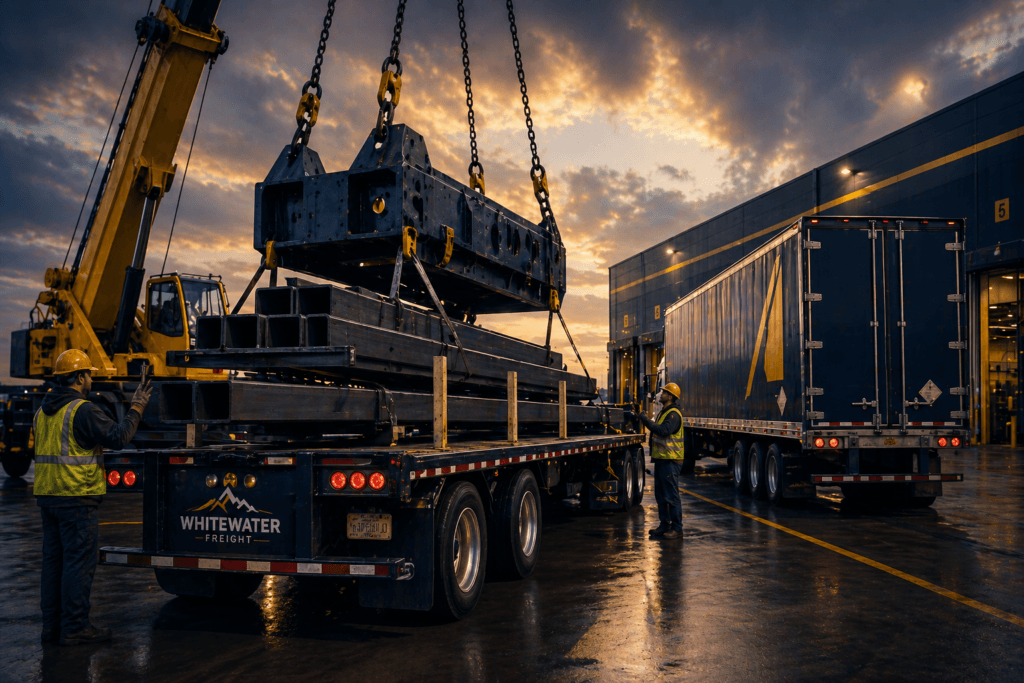
That means freight can be loaded from the top, sides, or rear—giving you a lot more flexibility than a traditional enclosed trailer.
It’s built for freight that simply doesn’t fit the standard mold.
What Is a Dry Van?
A dry van is the most common type of trailer in freight.
It’s enclosed, protected from the elements, and typically loaded from the rear.
For standard palletized shipments, it works great.
But it has limits—especially when it comes to size, shape, and loading requirements.
The Real Difference (It’s Not Just “Open vs Closed”)
The decision between flatbed and dry van usually comes down to more than just exposure to weather.
It’s really about:
Dimensions
If your freight is too tall, too wide, or too long for a standard trailer, a dry van simply won’t work.
Loading Requirements
If your shipment needs to be loaded by crane or forklift from the side, a flatbed is often the only option.
Shape and Configuration
Irregular or oversized items don’t fit neatly into enclosed trailers.
Securement Needs
Flatbed freight allows for specialized securement like straps, chains, and tarping.
When Flatbed Freight Is the Better Choice
Flatbed shipping is typically the right move when:
- Your freight is oversized or overweight
- Your shipment can’t be loaded through standard dock doors
- You need crane or side-loading access
- Your freight has unusual dimensions or shapes
This is especially common in industries like construction, manufacturing, and energy.
If that sounds like your world, it’s worth looking at the types of freight we support across different industries on our industries we serve page.
When a Dry Van Still Makes More Sense
Flatbed isn’t always the better option.
A dry van is usually the right fit when:
- Your freight is standard palletized goods
- You need protection from weather
- You’re shipping high-volume, consistent loads
It’s simpler—and often more cost-effective—when your freight fits within standard limits.
The Hidden Complexity of Flatbed Shipping
Flatbed freight isn’t just about picking a different trailer.
It adds layers of planning that many shippers don’t expect.
That includes:
- Proper securement methods
- Tarping requirements
- Weight distribution
- Permit considerations for oversized loads
This is where experience matters.
Because mistakes here don’t just cause delays—they can create safety issues.
Where Partial Load Can Fit In
Not every flatbed shipment requires a full trailer.
In some cases, a partial load shipment can reduce cost while still giving you the benefits of flatbed handling.
This is especially useful for mid-sized freight that doesn’t justify a dedicated truck.
How Whitewater Freight Helps
At Whitewater Freight, we don’t just ask “what’s the cheapest option?”
We look at what’s actually going to work.
That includes:
- Evaluating your freight dimensions and requirements
- Matching the right equipment
- Planning securement and handling
- Coordinating the full move from start to finish
If you want to see how we handle different types of freight, you can explore our full range of freight services.
The Bottom Line
Flatbed freight makes more sense when your shipment doesn’t fit inside the box—literally.
Trying to force the wrong equipment onto a shipment usually creates bigger problems later.
Getting it right upfront keeps things moving smoothly and avoids last-minute surprises.
FAQ
What types of freight require flatbed shipping?
Oversized, heavy, or irregularly shaped freight that cannot fit in a standard enclosed trailer.
Is flatbed shipping more expensive?
It can be, depending on the complexity of the load, but it’s often necessary for certain types of freight.
Can flatbed freight be protected from weather?
Yes, through tarping, though it’s not as fully enclosed as a dry van.
When should I avoid using a flatbed?
When your freight fits standard dimensions and requires full protection from weather or theft.
Freight without the surprise party.
Need help moving freight without the surprises?
Whitewater Freight helps shippers move truckload, LTL, flatbed, hot shot, and partial loads with proactive communication, careful carrier vetting, and real humans who answer the phone.
Get a Quote