

Market Update
July 2026 Freight Market Update: A Tighter, More Selective Market
July freight data shows a market that is not booming across the board, but is tightening in the places where capacity is already under pressure.
The July logistics market is showing a clear theme: freight conditions are becoming more selective. Not every lane is moving the same way, and not every equipment type is feeling the same pressure. But when capacity tightens, the hardest-to-cover freight is usually the first to reprice.
Based on July market data reviewed by Whitewater Freight, flatbed and reefer continue to show the strongest pressure. Dry van has firmed compared with earlier in the year, but it remains more lane-specific than flatbed or reefer.
National Freight Conditions Are Firmer, But Uneven
The national freight picture points to a market where pricing pressure is building even though shipment volume is not rising evenly across the board. That matters because rates can increase faster than freight volume when available capacity becomes more selective.
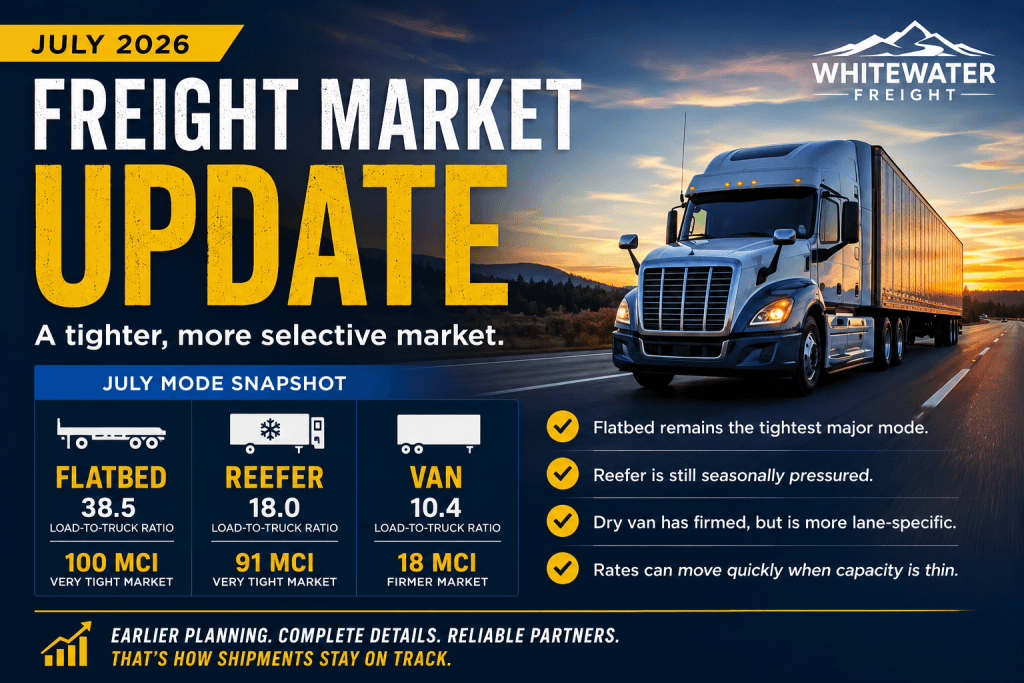
The clearest signal is that each equipment type is behaving differently. Flatbed remains the tightest major mode in the July data, reefer is still seasonally pressured, and van is firmer but more dependent on lane and region.
July Mode Snapshot
Flatbed Still Shows the Clearest Tight-Market Signal
Flatbed remains the most obvious tight-market signal in the July data. Construction demand, industrial freight, project timing, and open-deck requirements continue to keep capacity selective.
When flatbed freight has short lead time, strict pickup windows, oversized requirements, tarping needs, or limited delivery flexibility, available options can tighten quickly. This is especially true when multiple project moves or regional demand spikes happen at the same time.
For shippers, that means flatbed quotes may need to be treated with more urgency. The longer a shipment waits for approval, the more likely pricing or coverage can change.
Reefer Remains Seasonally Tight
Reefer is also still under pressure. Temperature-controlled freight is highly sensitive to produce timing, weather, appointment windows, and cold-chain requirements.
Even when overall freight conditions are not exploding, refrigerated capacity can tighten quickly in certain regions. A lane that looks manageable one day can become more difficult if produce volume, weather, or pickup timing shifts.
The key for reefer freight is preparation. Shippers should provide accurate product details, temperature requirements, pickup windows, delivery appointments, and any special handling instructions as early as possible.
Dry Van Is Firmer, But More Lane-Specific
Dry van has firmed compared with earlier market conditions, but it is not moving with the same broad pressure as flatbed or reefer. Coverage is still available in many places, but certain lanes can reprice faster when volume bunches up.
This creates an uneven market. One dry van lane may feel fairly normal, while another becomes difficult because of regional imbalance, compressed timing, or limited equipment availability.
That is why lane-specific planning matters. A national average can tell part of the story, but the real answer often depends on the origin, destination, equipment type, pickup window, delivery requirements, and timing.
Whitewater Freight Takeaway
Rates Can Move Quickly When Spare Capacity Gets Thin
July is a reminder that the freight market does not need to be in a full boom for rates to move. If available capacity is thin in the wrong place at the wrong time, pricing can react quickly.
That is especially true for flatbed and reefer freight, but it can also happen with dry van when freight bunches up around specific lanes or deadlines.
Why July Rates Can Move So Quickly
There are four big reasons rates can shift quickly right now.
1. Capacity Is Still Doing Most of the Work
Market data continues to show that pricing pressure can rise even when freight volume is not broadly surging. When capacity is limited or selective, rates can move faster than shipment counts.
2. Spot Pricing Is Still Repricing Upward
Dry van spot rates have been running higher than last year in several market readings, while July flatbed and reefer updates show strong midsummer pressure. That means shippers should be cautious about assuming old pricing will still hold.
3. Fuel Has Eased, But Not Enough to Reset Costs
Diesel eased from late June into early July, but fuel costs have not dropped enough to erase operating pressure for carriers. Fuel still matters, especially on longer routes and specialized freight.
4. Mode Pressure Is Not Even
Flatbed looks structurally hottest. Reefer remains seasonally tight. Van is firmer, but still more selective by lane. That means one shipment may feel calm while another becomes difficult quickly.
What Shippers Can Do to Reduce Surprises
In a selective market, the best protection is better information earlier in the process. The more complete the shipment details are, the easier it is to quote accurately, secure capacity, and avoid last-minute repricing.
- Quote freight as an estimate until the shipment is approved and booked.
- Build in time for repricing if approval is delayed.
- Provide weight, dimensions, commodity, equipment type, and timing early.
- Flag special requirements before the load reaches the pickup window.
- Watch pressured lanes before the customer gets boxed in.
How to Explain the July Market Simply
If you are talking through the market with customers, the simplest explanation is this:
Van is firmer, but still more lane-specific. Flatbed and reefer remain more reactive because they are tied to specialized requirements, seasonal timing, equipment constraints, and tighter pickup or delivery windows.
Whitewater Freight’s July Market Read
The July market is tighter in the lanes that were already under pressure. Flatbed and reefer remain the most reactive, while van has firmed but is still more selective by lane.
Rates can change quickly when capacity is thin, so earlier planning and dependable coverage matter more than they did a few months ago.
Whitewater Freight can provide a lane-specific read for customer routes, equipment types, or project timelines. That is especially helpful when freight involves flatbed, reefer, hot shot, expedited, partial, or tight pickup and delivery requirements.
Freight without the surprise party.
Need help moving freight without the surprises?
Whitewater Freight helps shippers move truckload, LTL, flatbed, hot shot, and partial loads with proactive communication, careful carrier vetting, and real humans who answer the phone.
Get a Quote