

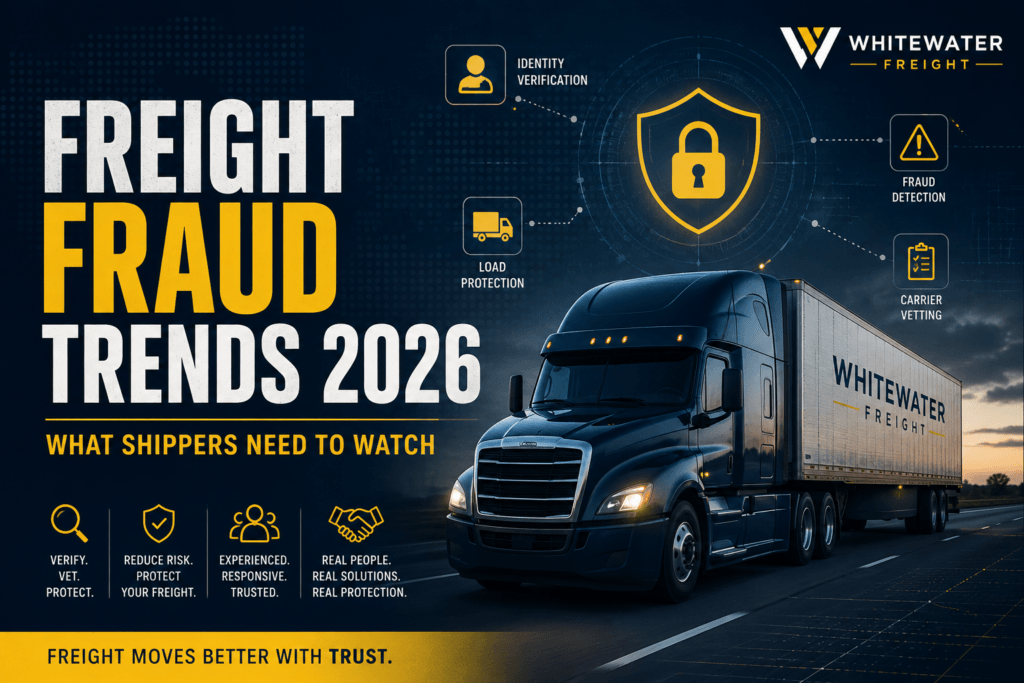
Freight Fraud Trends in 2026: What Shippers Need to Watch
Freight fraud is not new, but in 2026 it is getting more organized, more digital, and harder to spot before something goes wrong.
For shippers, that means protecting freight is no longer just about finding a truck and hoping the paperwork looks right. Fraud now involves stolen identities, fake carrier contacts, double brokering, altered documents, payment manipulation, and cargo theft schemes that can look legitimate on the surface.
In other words, the fraudsters have upgraded. Unfortunately, they did not use their powers for good.
Freight Fraud Is Becoming More Sophisticated
Industry reporting from DAT notes that freight fraud and cargo theft schemes are increasingly coordinated, often involving stolen identities, impersonated carriers, altered documentation, and legitimate-looking MC numbers paired with fake contact information. That matters because many scams no longer look obvious at first glance.
A carrier may appear legitimate. The paperwork may look normal. The phone number may work. The email may seem professional. But if the contact information has been spoofed or the identity has been stolen, the load can still be at risk before anyone realizes there is a problem.
This is why old-school vetting is not enough by itself. A quick glance at a DOT number or insurance certificate is not the same as confirming who is actually picking up the freight.
Trend 1: Identity Theft and Carrier Impersonation
One of the biggest freight fraud risks in 2026 is carrier impersonation. Bad actors may use the identity of a real carrier, including legitimate authority information, to book freight. Then they reroute the shipment, double broker it, or disappear with the load.
Truckstop’s Q1 2026 freight fraud report showed how much verification matters. Their risk and trust teams audited more than 15,000 freight accounts in the first quarter of 2026, with many blocked accounts tied to unqualified or unverifiable applicants. The report also pointed to fake ID issues as a leading cause of identity verification failures.
For shippers, the takeaway is simple: fraud prevention has to happen before the truck is assigned, not after the load is missing.
Trend 2: Double Brokering Is Still a Major Problem
Double brokering happens when a company accepts a shipment, then turns around and gives it to another carrier without proper authorization. Sometimes it is sloppy. Sometimes it is criminal. Either way, it creates risk for the shipper.
The danger is that the company listed on the paperwork may not be the company actually hauling the freight. That can create problems with tracking, liability, claims, communication, and payment. And when something goes wrong, everyone starts pointing at everyone else, which is not exactly a relaxing afternoon.
This is where strong carrier vetting, verified dispatch contacts, documented communication, and load tracking become important. The goal is not just to find a truck. The goal is to know who is actually moving the freight.
Trend 3: Cargo Theft Is More Strategic
Cargo theft is no longer just someone breaking into a trailer at a truck stop. Heavy Duty Trucking reported that cargo theft has shifted toward more strategic fraud, including identity theft, double brokering, phishing, cyber-enabled schemes, and fraudulent load bookings.
Verisk CargoNet reported 767 supply chain crime events across the United States and Canada in Q1 2026, with estimated losses of $131.58 million. Even though total incident volume was slightly down compared to prior periods, losses remained significant, and organized crime continued to reshape how theft occurs.
That is the part shippers should pay attention to. Fewer incidents does not automatically mean less risk. It may mean criminals are being more selective, targeting higher-value freight, better lanes, or weaker verification points.
Trend 4: Payment Fraud and Banking Changes
Freight fraud is not always about stealing the physical load. Sometimes the target is the money.
DAT has warned that payment-related schemes remain a growing risk, especially when attackers request changes to banking information or manipulate invoices during busy, high-pressure situations.
Any sudden request to change payment instructions should be treated carefully. That does not mean everyone is a villain. It does mean “please update our banking info” deserves more verification than “sure thing, internet stranger.”
Trend 5: High-Pressure Freight Creates More Openings
Urgent freight can create risk because everyone is moving quickly. When a shipment is late, production is waiting, or a customer is upset, it is easier for details to get skipped.
Fraudsters understand that. They look for urgency, confusion, after-hours communication, unfamiliar contacts, and weak handoffs.
That is why expedited freight, high-value freight, and time-sensitive shipments need extra discipline. Speed matters, but speed without verification is how problems sneak in wearing a reflective vest.
What Shippers Should Watch For
Shippers do not need to become freight fraud investigators overnight. But they should know the warning signs.
- A carrier contact does not match the information listed with official records.
- A dispatcher pushes for quick approval but avoids detailed questions.
- Insurance documents look unusual, outdated, or difficult to verify.
- The pickup driver information changes at the last minute.
- The carrier asks to change delivery instructions mid-route.
- Tracking is resisted, delayed, or inconsistent.
- Payment instructions change unexpectedly.
- The rate is far below market in a way that feels too good to be true.
One red flag does not always mean fraud. But multiple red flags should slow the process down.
How Whitewater Freight Helps Reduce Risk
At Whitewater Freight, fraud prevention is not an afterthought. It is part of how freight should be handled from the beginning.
We help protect shippers by focusing on details that matter before the load moves, including carrier vetting, authority checks, insurance review, communication, tracking expectations, and documentation. The point is not to make the process more complicated. The point is to keep one bad decision from turning into a missing load, a denied claim, or a very long week.
Freight moves better when people are paying attention. Technology matters, but it still takes experienced humans asking the right questions, checking the right details, and noticing when something feels off.
What Shippers Can Do Right Now
If you ship freight, here are a few practical steps worth taking:
- Work with logistics partners who take carrier vetting seriously.
- Verify carrier authority, insurance, and contact information before pickup.
- Be cautious with last-minute changes to driver, dispatcher, or delivery details.
- Require clear tracking expectations on shipments.
- Use extra care with high-value, urgent, or easily resold freight.
- Confirm payment changes through a trusted secondary channel.
- Do not let urgency override common sense.
The Bottom Line
Freight fraud in 2026 is not just a carrier problem, a broker problem, or a shipper problem. It is a supply chain problem.
The companies that handle it best will be the ones that slow down just enough to verify the important details before speeding the freight down the road.
At Whitewater Freight, we believe freight should move with urgency, but not recklessness. Because getting the load there matters. Knowing who has the load matters too.
And when the freight world gets messy, we would rather be the people helping clean it up than the people saying, “Well, that looked fine on the load board.”
Sources
- DAT Freight & Analytics: Freight fraud trends to watch this year
- Truckstop: Q1 2026 Freight Fraud Trends Report
- Verisk CargoNet: 2026 First Quarter Supply Chain Risk Trends Analysis
- Heavy Duty Trucking: Cargo Theft’s New Playbook
Freight without the surprise party.
Need help moving freight without the surprises?
Whitewater Freight helps shippers move truckload, LTL, flatbed, hot shot, and partial loads with proactive communication, careful carrier vetting, and real humans who answer the phone.
Get a Quote