

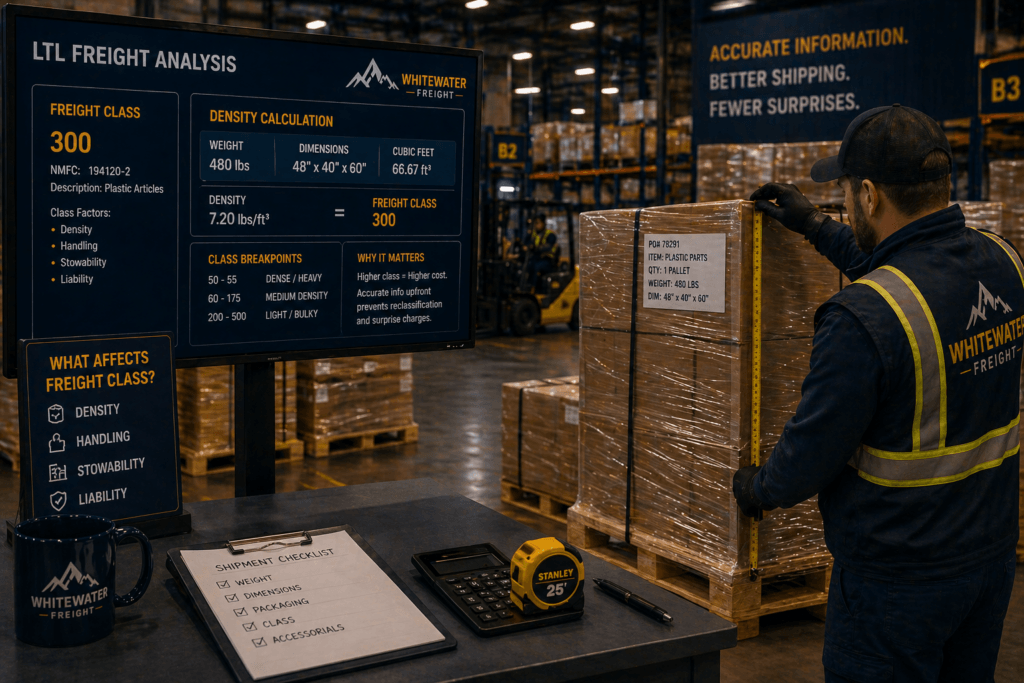
Freight Class, Density, and Why LTL Shipping Gets Weird
If you’ve ever shipped LTL freight and thought, “Why did the price change after pickup?”—you’re not alone.
LTL shipping has a reputation for being… unpredictable.
And most of that comes down to one thing:
Freight class.
Let’s break down what that actually means—and why it can make LTL feel a little weird if you’re not expecting it.
What Is Freight Class?
Freight class is part of a standardized system used in LTL shipping to categorize freight.
It helps carriers determine pricing based on how easy—or difficult—a shipment is to handle.
Classes typically range from 50 to 500.
Lower class = easier to ship.
Higher class = more difficult (or riskier) to ship.
What Determines Freight Class?
Freight class is based on four main factors:
1. Density
This is the big one.
Density is how much your freight weighs compared to how much space it takes up.
Heavier, compact freight = lower class.
Light, bulky freight = higher class.
2. Handling
If freight is difficult to move, stack, or secure, it may be assigned a higher class.
3. Stowability
Can it be loaded with other freight easily?
Odd shapes or hazardous materials can impact this.
4. Liability
Higher risk of damage or theft = higher class.
Why Density Matters So Much
In many cases, density is the biggest driver of LTL pricing.
Even small changes in dimensions can shift a shipment into a different class.
And that’s where surprises start.
If the dimensions or weight are incorrect, carriers may reclassify the shipment after pickup.
That usually means:
- Higher cost
- Adjusted invoice
- Confusion (and frustration)
Why LTL Pricing Feels “Weird”
LTL pricing is not just based on distance.
It’s influenced by:
- Freight class
- Dimensions and weight
- Accessorials
- Carrier network routing
That combination can make pricing feel inconsistent—especially if details change.
This is also why some shipments may actually be better suited for partial load shipping or even truckload shipping, depending on size and urgency.
The Most Common Mistake
The biggest issue we see is inaccurate shipment information.
That includes:
- Incorrect dimensions
- Estimated weights
- Missing packaging details
Even small differences can trigger reclassification.
And that’s where pricing changes happen after the fact.
How Whitewater Freight Helps
At Whitewater Freight, we focus on getting the details right before the shipment moves.
That includes:
- Confirming dimensions and weight
- Helping determine accurate freight class
- Identifying potential issues upfront
It’s part of how we reduce surprises and keep shipments running smoothly.
You can see how this fits into our broader approach on our freight services page.
The Bottom Line
LTL shipping isn’t random—it just has more variables.
Understanding freight class and density helps make sense of the pricing.
And getting those details right upfront makes everything a lot more predictable.
FAQ
What is freight class in LTL shipping?
A system used to categorize freight based on density, handling, stowability, and liability.
Why does freight class affect pricing?
Because it reflects how difficult or risky a shipment is to move.
What is freight density?
The weight of the freight divided by its volume (space it occupies).
Can freight class change after shipment?
Yes, if the original information is inaccurate, carriers may reclassify the shipment.
Freight without the surprise party.
Need help moving freight without the surprises?
Whitewater Freight helps shippers move truckload, LTL, flatbed, hot shot, and partial loads with proactive communication, careful carrier vetting, and real humans who answer the phone.
Get a Quote